
Tag: Health insurance

  • Navigating Prescription Drug Coverage – A How-To Guide

    Navigating Prescription Drug Coverage – A How-To Guide

    Have you ever wondered why knowing your prescription drug plan could save you lots of money each year? Many people don’t pay enough attention to choosing their medication insurance. But, getting it right can help avoid extra costs and worry. This guide makes the tricky parts of Rx coverage clear. It helps you look at different drug benefit plans, figure out what medicines you need, and make smart choices to use your coverage well12.

    Key Takeaways

    • Understanding prescription drug coverage is crucial for managing medication costs effectively.
    • Different plans, such as Medicare Part D, can significantly impact your healthcare expenses.
    • Assessing current and future medication needs helps identify the best coverage options.
    • The drug formulary outlines which medications are covered and their tier placements.
    • Navigating costs, including premiums and copayments, is essential to budget healthcare expenses.
    • Accessing copay assistance programs can alleviate financial burdens associated with medications.

    Understanding Prescription Drug Coverage

    Prescription drug coverage is key in healthcare. It helps people pay for needed medicines. This part of health plans includes a list of drugs and how much they cost. Knowing about this can help patients choose wisely about their medicine insurance.

    What is Prescription Drug Coverage?

    Prescription drug coverage is part of health insurance that covers medicine costs. These plans put drugs into tiers based on price. For example, Tier 1 has cheaper generic drugs. Higher tiers have costly brand-name drugs. Medicare drug plans use this system to control costs. This helps people know their prescription charges3.

    Importance of Having Coverage

    Having this coverage is crucial. It gives access to needed medicines, stops money problems, and lets people focus on health. For example, Medicare makes sure patients pay no more than $35 a month for insulin. With many adults needing medicine, this coverage is vital for health management4.

    Lacking good coverage, some can’t afford their medications. This leads to missed treatments. Some states help Medicare users with these costs. Knowing your drug plan helps you take care of your health. It ensures you can handle expenses and get necessary medicines3.

    Types of Prescription Drug Coverage Plans

    Learning about prescription drug plans helps you get medications. We’ll look at important plans. This includes Medicare Part D, Employer plans, and Medicaid Drug plans.

    Medicare Part D Plans

    Medicare Part D is key for those over 65 or with disabilities. You buy these plans from insurance companies. They differ in costs and the drugs they cover5. Each plan must offer at least two drugs in every category6.

    You enroll with the insurance you pick. Each year, you can choose a new plan during a special time5.

    Employer or Union Health Plans

    Job or union health plans offer drug coverage too. Employers work with PBMs for better drug prices. This makes employee costs lower. These plans can change with yearly negotiations.

    Medicaid Prescription Drug Plans

    Medicaid helps those with low incomes get medications. You must meet income requirements. States set their own Medicaid rules, including co-pays and drug rules.

    Plan Type Who It Covers Key Features
    Medicare Part D Seniors and disabled individuals Varies by provider; covers at least 2 drugs per category
    Employer/Union Plans Employees and union members Negotiated pricing; may change annually
    Medicaid Low-income individuals State-specific coverage; prior authorizations required

    657

    Assessing Your Medication Needs

    Knowing what meds you need is key for the right drug plan. Checking your current and future med needs helps avoid extra costs. It keeps you healthy.

    Identifying Your Current Medications

    List your current meds, how much, and how often you take them. This helps compare plans to find the best one. Over 20% of older adults in the U.S. take five or more drugs, showing we need to manage them well8.

    Check your meds often to make sure the amounts are still right. Our bodies change how they handle drugs as we get older8.

    Evaluating Future Medication Needs

    Think about long-term conditions that might need meds later. Doctors check patients a lot across their careers, showing why we must keep evaluating our needs9. Choosing plans with lower costs helps with long-term meds for chronic conditions.

    Tools like pill organizers help manage many meds and avoid mistakes8. Ask about cheaper generic drugs at the pharmacy to save money if you can8.

    Proper assessment of your medication needs ensures optimal health management and financial efficiency.

    Make your med list and look at different plans to find what works for you. Knowing each plan’s details helps make your choice easier.

    Looking at your now and future med needs is important. This proactive step helps with costs and keeps you healthy10.

    Decoding The Drug Formulary

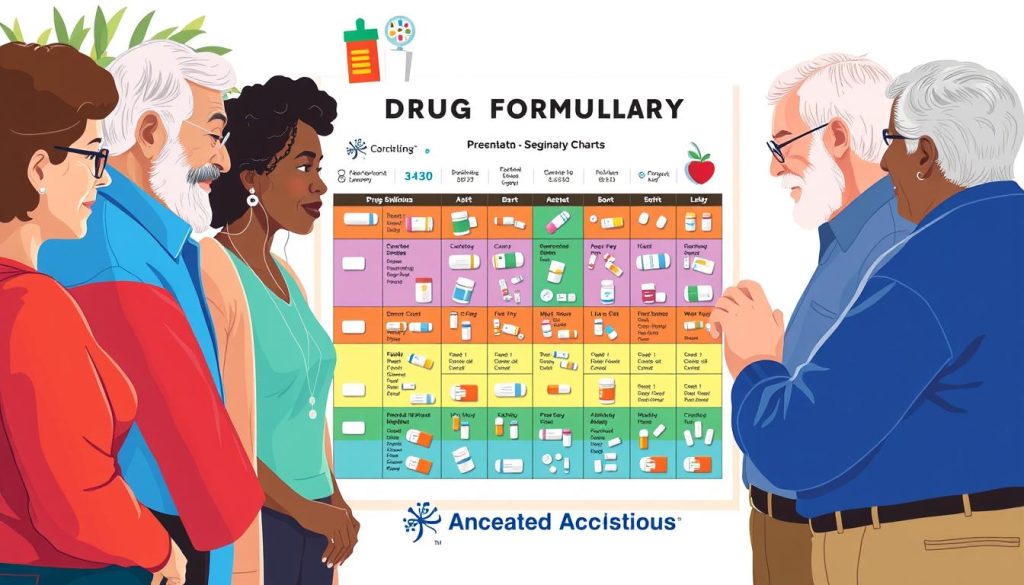
    Getting to know the drug formulary is key if you deal with prescription drug plans. This list shows what meds are covered, breaking them into groups that affect cost. Knowing this list helps you choose wisely and save money on meds.

    What is a Drug Formulary?

    It’s a big list of meds that insurance plans cover. It tells which meds you can get and how much you pay. For many people, especially those over 65 or with certain disabilities11, it helps make important meds affordable.

    Understanding Formulary Tiers

    The formulary has tiers, sorting meds by how much you share the cost. Tier 1 has generic drugs, which are cheaper. Tier 2 has brand names with higher costs, and Tier 3 has special meds that cost the most12. Knowing these tiers helps manage your spending.

    Identifying Covered Medications

    Knowing what meds are covered is crucial to avoid surprises and treatment waits. Your plan decides what drugs are available and how much you pay. Some drugs can be really expensive without coverage11. Programs like CDPHP’s Rx for Less offer big discounts on certain drugs, showing why it’s good to understand your formulary12.
    drug formulary

    Navigating Costs Associated with Coverage

    Understanding prescription drug coverage costs helps manage healthcare money. These costs have insurance premiums, deductibles, and copayments. The average Affordable Care Act (ACA) plan deductible for 2024 is $3,05713. Around 50.5 million people with Medicare have Part D plans in 2023. They deal with these costs13.

    Premiums, Deductibles, and Copayments

    Insurance premiums are what you pay every month for coverage. Deductibles are what you pay before your coverage starts13. Copayments depend on the drug’s tier. There are four tiers for drugs, based on price and how well they work. Tier 1 has the lowest copayment for generic drugs. Tier 2 has a higher copayment for affordable brand-name drugs14.

    Out-of-Pocket Costs Explained

    Out-of-pocket costs also include coinsurance and costs for drugs not on your plan’s list. Tier 3 drugs cost the most in copayments. They are brand-name drugs with generic options available. Tier 4 drugs are special ones that need approval first14. Planning for these costs is vital. Americans spend about $1,432.30 each on medications yearly13.

    Finding the Right Pharmacy

    Finding a good pharmacy is very important for your health. You might want a pharmacy that is easy to get to, saves you money, or one you can trust. Knowing the difference between pharmacies that your insurance covers and mail-order ones is key.

    In-Network vs. Out-of-Network Pharmacies

    Going to pharmacies that your insurance covers can save you money. These places may charge you less for your medicine. But, pharmacies not covered by your insurance might cost more. This could make you spend more money than you want to.

    A study found that many people think highly of their local pharmacist’s knowledge15. Also, very few have had problems with not getting their medicine on time at these pharmacies15.

    Mail-Order Pharmacies

    Mail-order pharmacies are very handy. They can save you money, especially if you buy your medicine in big amounts at once. For example, Optum Home Delivery Pharmacy offers deals when you buy more16.

    Some of these services have insulin and other medicines for $35 or less for a month16. Also, a lot of people say they have trouble finding some medicines in stores. This shows that mail-order might be more reliable for getting your medicine15.

    Thinking about pharmacies covered by your insurance and looking into trustworthy mail-order options can really help. You can use tools like the UnitedHealthcare app to find good pharmacies and handle your medicine needs better.

    Type of Pharmacy Advantages Disadvantages
    In-Network Pharmacies Lower costs, quality service, knowledgeable staff Limited to pharmacy network
    Out-of-Network Pharmacies More choices Higher out-of-pocket costs
    Mail-Order Pharmacies Convenience, potential savings on bulk orders Delivery delays, may lack personal consultation

    Making a smart choice between pharmacies covered by your insurance and mail-order options can improve your health and save you money17.

    Utilizing Copay Assistance Programs

    It can be tough for lots of Americans to pay for their prescriptions. Copay assistance programs help a lot with these costs. They are put together by drug companies or groups that want to help. These programs make it easier to get the medicines people need, especially if they are very sick.

    What is Copay Assistance?

    Copay assistance helps people pay for their medicine. Americans spend more than $1,000 each on prescription drugs every year. This can be really hard for people who need lots of medicines. Because of the cost, nearly three out of ten adults skip their medicines. This shows how vital copay assistance is. It lets people get their needed treatments without spending too much.

    How to Access Programs

    To use these programs, there are a few steps to check if you qualify. You might need to show how much money you make. You could also need papers about your health insurance. Talking to the drug companies or a health helper can make this easier. You can learn more by clicking here. Also, 28% of people have used copay help, proving it works well for lowering medicine costs18.

    Lately, more people are dealing with copay maximizers and accumulators. These can make getting help harder19. There is a push for better rules because these challenges can be big. Yet, over 70% of people think copay programs are good. They see how important these programs are in healthcare18.

    Applying for Prescription Drug Coverage

    When you think about getting coverage for prescription drugs, it’s key to know who can apply. Each plan has rules about things like age, income, and health conditions. Nearly everyone with Medicare, about 90%, can get this helpful coverage20. Knowing these details can help you find the best coverage for you.

    Eligibility Requirements

    Who can get into a plan can change, especially with Medicare. If you’re close to 65, you have a 7-month period to sign up for Medicare Part D21. If you wait too long, you might have to pay extra, as about 36% of people do20. It’s really important to know when you can apply to avoid extra fees.

    Application Processes for Various Plans

    Applying for drug coverage changes depending on the plan. For Medicare, there are specific times to enroll, like from October 15 to December 7 each year21. You should talk to a few plans to get details on costs since they can vary a lot20. Also, if you already have insurance through work or a union, see how it fits with new coverage20.

    applying for coverage

    Managing Your Coverage Over Time

    Checking your prescription drug coverage often is key, especially when things change. Doing a yearly plan review helps. It makes sure your coverage matches your current needs. You can spot any coverage gaps or better options.

    Annual Review of Your Plan

    Doing a yearly plan check is a good chance to look over your meds. It’s normal for your meds to change during the year. A yearly review helps see if your coverage is still right. It’s important to keep an eye on health changes. This ensures you’re getting the most from your benefits while managing your coverage well.

    Making Changes to Your Coverage

    Big life events might mean you need to adjust your coverage. Knowing how to handle these changes is important for your care. If you have Medicare Part D and TRICARE for Life, Medicare pays first. TRICARE covers the rest22. If changes are needed, the TRICARE Formulary Search Tool can help make the process easier.

    Aspect Details
    Annual Plan Review Essential for assessing whether your current plan aligns with your health needs.
    Coverage Changes Necessary during life transitions such as new prescriptions or financial adjustments.
    Resources Available TRICARE Formulary Search Tool, Express Scripts online account, and mobile app.

    Focusing on reviews and knowing your resources can really help. You can manage your prescription coverage much better222324..

    Conclusion

    It’s important to understand your prescription drug coverage. This helps you get the medicines you need without spending too much. There are many plans like Medicare Part D or employer health plans. Each one has different benefits. In 2001, a survey showed that not all seniors have good drug coverage. Some states only have 20% coverage while others have 38%. This shows how hard it can be to find good help for health needs25.

    The cost of healthcare is rising fast. From 2012 to 2016, spending on prescriptions went from $250.7 billion to $341.0 billion26. This means it’s key to plan your budget and look into all the help you can find. Things like copay assistance programs and checking your coverage every year are smart moves.

    Now, more people are using specialty drugs. This means we need better rules to help seniors with low income25. Being smart about your coverage options can make your health care better. It can also make sure you’re not worried about costs in the future. Learning more and using the right resources is the best way to manage your prescriptions.

    Source Links

    1. Medicare Part D Manual
    2. How to enroll in prescription drug coverage – Medicare Interactive
    3. TIPS FOR UNDERSTANDING YOUR DRUG COVERAGE & PRESCRIPTIONS
    4. An Overview of Prescription Drug Insurance
    5. What is a PDP (Prescription Drug Plan)?
    6. What Medicare Part D drug plans cover
    7. Medicare Prescription Drug Plans
    8. Medication Management and Safety Tips
    9. Chapter 6. The Assessment
    10. What should I look for in a Medicare Prescription Drug Plan?
    11. Unveiling Prescription Drug Coverage: The Medicare Connection | Decent
    12. Decoding your Rx Benefits
    13. Prescription Drug Insurance Plans: Coverage & Costs | eHealth
    14. Understanding Drug Tiers – Patient Advocate Foundation
    15. Finding the Right Pharmacy – Consumer Reports Magazine
    16. Shop Medicare prescription drug plans
    17. Pharmacy and prescription drugs
    18. Patient perspectives and use of copayment assistance during the COVID-19 pandemic
    19. Copay Adjustment Programs: What Are They and What Do They Mean for Consumers? | KFF
    20. How to get prescription drug coverage
    21. How to enroll in a Medicare Part D prescription drug plan
    22. Understanding Medicare Part D and TRICARE Pharmacy Coverage
    23. A Current Snapshot of the Medicare Part D Prescription Drug Benefit | KFF
    24. Prescription Drug Coverage and Effects on Drug Expenditures among Elderly Medicare Beneficiaries
    25. Prescription drug coverage and seniors: how well are states closing the gap? – PubMed
    26. The Prescription Drug Landscape, Explored
  • Understanding Medicaid Eligibility in the US

    Understanding Medicaid Eligibility in the US

    Have you ever wondered why millions of Americans rely on Medicaid for their health care needs, yet many remain unaware of their eligibility? Medicaid is important for low-income families, kids, pregnant women, the elderly, and people with disabilities. It offers key medical benefits. In FY 2021, Medicaid spending was huge at $728 billion, with 69% paid by the federal government1. States set their own rules for who can get Medicaid. This makes knowing if you qualify both tricky and important.

    This article helps understand Medicaid eligibility. It will show who can get this help and how to apply. Almost two-thirds of folks who leave Medicaid end up without insurance for a bit1. Knowing about Medicaid can help people get the health care they need.

    Key Takeaways

    • Medicaid offers essential health care access to low-income individuals and families.
    • Eligibility criteria vary by state and include factors like income, age, and family size.
    • Medicaid accounted for 27% of total state expenditures in FY 20211.
    • Understanding the Medicaid application process is crucial for securing coverage.
    • Many individuals may still qualify for benefits despite high income through programs like CHIP.

    What is Medicaid?

    Medicaid is an important program run by the federal and state governments. It helps people with low income get healthcare. Millions rely on it for doctor visits, hospital stays, long-term care, and more. Each state has its own rules and coverage options to help its residents.

    In states with expanded Medicaid, your income decides if you can get help. If your family earns less than 138% of the federal poverty level, you might qualify2. Before, adults aged 18 to 65 with low income could get coverage. Now, some states still haven’t expanded Medicaid. This means some people don’t have any coverage at all2.

    Medicaid does more than cover basic health needs. It can pay for 90 days of past medical bills if you’re eligible3. Whether you’re a citizen, green card holder, or have certain visas also matters3. Medicaid looks at different income levels for kids, adults, pregnant people, and those with disabilities3.

    To wrap up, understanding Medicaid is key to accessing healthcare. It shows the effort to care for those in need in the U.S. As states choose what coverage to offer, knowing about Medicaid can help a lot.

    Who is Eligible for Medicaid?

    Medicaid is for people with low income and follows rules made by the government. It helps adults with little money, kids, pregnant people, older adults, and those who are disabled. States can make more people eligible if they choose4.

    Some states let people pay medical bills to meet Medicaid’s money rules. This is called “spend down.”5 If you qualify for Medicaid and Medicare, you get more services5.

    Medicaid helps pay for Medicare costs like monthly payments, deductibles, and co-pays5. This support is key. It lets eligible people get care without huge costs. Medicaid and CHIP together support families with low income and protect them from high health costs4.

    Medicaid might cover past medical care for three months if you qualify4. If you were in foster care, you can get Medicaid until you’re 264. To figure out if you can get Medicaid, talk to your local Medicaid office. They can help you apply.

    Medicaid Eligibility Criteria

    Knowing how to qualify for Medicaid is key. It depends on where you live, if you’re a citizen, and how much money your family makes. In North Carolina, more people aged 19 to 64 can now get Medicaid6. A single adult earning up to $1,732 a month may qualify6. This limit goes up with more family members, showing the need to think about family size6.

    In Pennsylvania, Medical Assistance helps certain groups like kids under 18 and pregnant women. They qualify if their income is 133 percent of the Federal Poverty Guidelines or less7. They consider income from jobs and pensions, but not benefits like SNAP7. You need the right papers, like a Social Security Number and proof of where you live7.

    Illinois has special Medicaid programs for kids and parents of kids8. They look at how much money you make and if you’re legally in the U.S8.. People with permanent residency may get help without hurting their chance to become citizens8.

    Medicaid rules can be complicated and differ by state. This affects how people get the healthcare they need.

    Medicaid Income Guidelines

    Medicaid income guidelines help figure out who can get low income health insurance. Each state has its own rules for how much money you can make to qualify, based on the federal poverty level. For example, a single person can qualify with an income of $1,732, while a family of eight can qualify with $6,0639. Monthly income eligibility for low-income families starts at $590 for one person and goes up to $1,343 for bigger families9.

    There are special rules for different groups of people. A single pregnant woman can qualify with an income of $1,732, the same as a large family of eight pregnant women with $6,0639. In California, if you’re single or married, the income limits for Medicaid waivers are $1,732 and $2,352 per month10. Alaska sets the limits at $1,751 for singles and $2,593 for married couples10.

    What you own also matters for Medicaid. You can have a house, one car, and certain exempted resources. A single person’s resources can’t be more than $4,000. A two-person family’s resources can’t top $6,000, adding $25 for each extra person11. Kids under 18 and pregnant women don’t need to worry about this resource test. This makes applying easier for them11.

    Medicaid income guidelines

    Group Monthly Income Eligibility
    Single Individual $1,732
    Household of Eight $6,063
    Low-Income Families $590 – $1,343
    Pregnant Women (Single) $1,732
    Pregnant Women (Household of Eight) $6,063
    Regular Medicaid (Alaska, Singles) $1,751
    Regular Medicaid (California, Singles) $1,732

    Age and Medicaid Eligibility

    Understanding Medicaid eligibility by age shows big differences, especially for kids and the elderly. Children under 19 can often qualify thanks to programs like CHIP, which have higher income limits. This helps families afford health care. But, for seniors 65 and older, things like income and what you own matter more. States set these rules to decide who gets Medicaid12. Seniors have to meet specific income limits. For example, some places have a monthly income cap of $2,901 for Nursing Home Medicaid13.

    Each state has its own rules about how much money you can make to qualify. For Aged, Blind, and Disabled Medicaid, this amount changes a lot. Some states put the limit around $967 monthly, but others allow as much as $1,25513. Knowing these rules is super important for older folks.

    Also, Medicaid requires that you must be a citizen or a qualified alien to get benefits12. These rules make sure people who really need help can get it. They aim to provide care to those most in need.

    Special Considerations for Pregnant Women and Children

    Medicaid is very important for both moms and babies. It keeps them healthy. The number of births covered by Medicaid went up a lot after changes in the 1980s. Before these changes, less than half of the women in need got help in 198414. By 1991, Medicaid paid for 32% of all baby deliveries. This was a big increase from 15% in 198514.

    Pregnant women can get Medicaid easier than others. They can have higher income and still qualify15. This helps them get care before the baby is born. It leads to healthier babies. This is very important for babies of color. They are more likely to get this help16.

    Medicaid helps kids get doctor visits, shots, and care in emergencies. Even if a family makes a lot of money but has big medical bills, they can get help15. This helps families take care of their health without worrying about the cost.

    Medicaid makes it easier for people who need help to get it. This is good for pregnant women and kids. They have made some changes so people can sign up faster. These changes help everyone be healthier and more equal16.

    Criteria Medicaid for Pregnant Women Medicaid for Children
    Income Eligibility Higher limits, often above $2,130 Varies, typically below federal poverty level
    Coverage Services Comprehensive prenatal services Routine check-ups, immunizations, emergency services
    Impact on Health Improves maternal and infant health Significant reduction in child health disparities
    Administrative Measures Reforms to ease enrollment Medically needy pathway available

    Medicaid Application Process

    The Medicaid application process is different in each state. Some states ask you to apply in person. Others let you do it by mail, online, or on the phone. Places like health centers can also help you apply17. You need to fill out a form with your personal info, money you make, and who lives in your house. It’s important to have proof of when you were born, if you’re a U.S. citizen or live here legally, what money you get, and other assets. Don’t forget your Medicare card if you have one17.

    Knowing how to apply for Medicaid the right way can make things less stressful. State agencies usually decide on applications in 45 days. But if it’s about a disability, it might take up to 90 days18. If you don’t send the needed papers on time, you might have to start over. This can make getting Medicaid take longer18. Local offices can help with applying for long-term care. They check if you qualify18.

    You can pick someone to help you apply. Make sure this person knows a lot about your situation and money matters18. If your money or what you own changes, tell Medicaid right away. They check every year if you still qualify. You need to show papers that prove these changes18.

    If you need special services like Nursing Home Medicaid, know what you have to show. This includes your home’s worth and if you have a mortgage. Mistakes in deciding if you qualify happen 25% to 35% of the time. This shows why it’s so important to have the right papers19.

    Getting into Medicaid needs you to pay attention to details and what you need to show. Knowing what your state asks for helps make applying easier. It also helps get your eligibility checked faster.

    Documentation Required for Medicaid Application

    When you apply for Medicaid, you need the right documentation for Medicaid. You must show Medicaid necessary documents. These prove who you are and where you live.

    Start with your ID. You can use a Driver’s license, Military ID, or school records if you’re under 16. You also need to show you’re a U.S. citizen. You can use a Birth Certificate or a State Department certificate20.

    You need your Social Security papers too. This could be an award letter from Social Security. To show how much money you make, bring pay stubs or letters from relatives21.

    If you get military benefits, bring those letters. You should also have proof of any money from rentals or royalties. A 1099 form or a bank statement will work for this20.

    Make sure your home proof is up to date, within the last six months. Each state has different rules. To make things easier, check with your local Medicaid office. For more info, click here: official guidance.

    Understanding Medicaid Coverage Criteria

    Medicaid programs offer many Medicaid benefits for different health needs. Each state has its own rules for what services they provide. For example, in Washington State, it’s called Apple Health. This program helps people who qualify22.

    To get Medicaid service coverage, things like how much you earn, your age, and where you live matter. There are plans for kids, pregnant people, and older adults5. Classic Medicaid is for people 65 and up or those who need a lot of care. MAGI Medicaid is for working adults, their kids, and people who care for them22.

    Learning about these programs helps people choose the right care. It’s great for those who can get both Medicaid and Medicare. They get full coverage, help with Medicare costs, and more5.

    Medicaid Program Type Eligibility Criteria Services Covered
    Classic Medicaid Aged 65 and older; disabled Long-term care; hospital services
    MAGI Medicaid Adults and children under income limit Routine medical visits; preventive services
    Dual Eligibility Eligible for both Medicare and Medicaid Extra Help for medications; coverage of copayments

    For more info on your state’s Medicaid coverage criteria, visit your local Medicaid office. It helps a lot! You can find out what care you can get and get help during the application process.

    Medicaid Enrollment Process

    The Medicaid enrollment process is open all year. This means people can sign up anytime.Medicaid sign-up is not limited like private insurance is. Once approved, members get lots of health benefits. These are important for staying healthy.

    States check if people still qualify for Medicaid, especially after a big increase in members. This happened when the rules about dropping people were paused. Then, Medicaid and CHIP members grew by 32%, reaching 94.1 million.

    If you want to know how to enroll in Medicaid, keep your info current. This helps you keep your benefits without a break. Many states now make renewing easier with automatic checks.

    Working with community groups helps a lot during renewal times. Most states do this to make things smoother. They want to keep making the Medicaid enrollment process better. This shows they care about helping everyone get and stay enrolled.

    Medicaid enrollment process

    Conclusion

    Learning about Medicaid is important for people who want affordable health care in the U.S. Knowing about things like income rules and what papers you need helps. This knowledge makes applying easier and helps people get the health care they need.

    Lots of checks between 2014 and 2018 found mistakes in how Medicaid decided if people could get it. Often, the mistakes were about how much money people said they made23. Thanks to ACA (Obamacare), more people, especially in Black and Hispanic groups, got Medicaid24. This has helped many people get better health care and has also been good for the states24.

    People need to keep learning about Medicaid so they can take care of their health. By checking if they can get Medicaid and signing up, people can make sure they get help. This helps everyone live healthier and happier lives25.

    Source Links

    1. 10 Things to Know About Medicaid | KFF
    2. Medicaid expansion & what it means for you
    3. Medicaid – OCHIA
    4. Medicaid & CHIP coverage
    5. Medicaid
    6. NC Medicaid Eligibility | NC Medicaid
    7. Medicaid General Eligibility | Department of Human Services
    8. Introduction to Medicaid
    9. Department of Social Services
    10. Medicaid Eligibility Income Chart by State (Updated Nov 2024)
    11. Medicaid Eligibility
    12. Eligibility
    13. 2025 Income, Asset & Care Requirements
    14. Medicaid and Pregnant Women: Who is Being Enrolled and When
    15. Medicaid Eligibility | ACL Administration for Community Living
    16. State Approaches to Simplify Medicaid Eligibility and Implications for Inequality of Infant Health
    17. How to apply for Medicaid – Medicare Interactive
    18. Applying for Medicaid | ACL Administration for Community Living
    19. How to Apply for Medicaid Long-Term Care
    20. DOCUMENTS NEEDED WHEN YOU APPLY FOR HEALTH INSURANCE
    21. What do I need to apply for Medicaid?
    22. Understanding Medicaid and Medicare
    23. GAO-20-157, MEDICAID ELIGIBILITY: Accuracy of Determinations and Efforts to Recoup Federal Funds Due to Errors
    24. The Effects of Earlier Medicaid Expansions: A Literature Review | CEA | The White House
    25. Brief Summaries of Medicare & Medicaid